China’s kitchen storage systems are changing how compact and busy homes handle daily cooking. Cabinets now use pull-out baskets, corner drawers, lift-up doors, and adjustable dividers. These features are not merely decorative. They should reduce wasted movement, improve visibility, and keep essential items within comfortable reach.
Susan Serra, CKD, a respected kitchen designer and author, expresses the guiding principle clearly: “Design the kitchen around the way you live.” Her statement helps explain what makes a kitchen storage system efficient. Efficiency begins with real behavior. A family that cooks rice daily needs a different layout from a household that mostly orders food. A baker may require deep drawers for flour and trays. A small apartment may need vertical storage for pans and cutting boards.
China’s leading manufacturers often combine practical engineering with flexible customization. Soft-close runners, reinforced hinges, corrosion-resistant baskets, and smooth sliding tracks support repeated use. Modular sizes also help designers fit storage into narrow walls and irregular corners. A well-planned pull-out pantry can show every jar at once. That simple detail can prevent forgotten ingredients and unnecessary purchases.
Still, efficiency is not guaranteed by adding more hardware. Too many compartments can create confusion. Deep storage may hide small tools. Glossy finishes can show fingerprints quickly. These are easy mistakes to overlook. A reliable system balances capacity, access, cleaning, safety, and long-term durability. Factory testing, material inspection, and clear installation guidance also matter.
This guide examines what makes a kitchen storage system efficient, especially in China’s competitive kitchen furniture market. It compares functional layouts, hardware quality, customization options, and everyday usability. The best solution is not always the largest one. It is the system that quietly makes cooking easier.
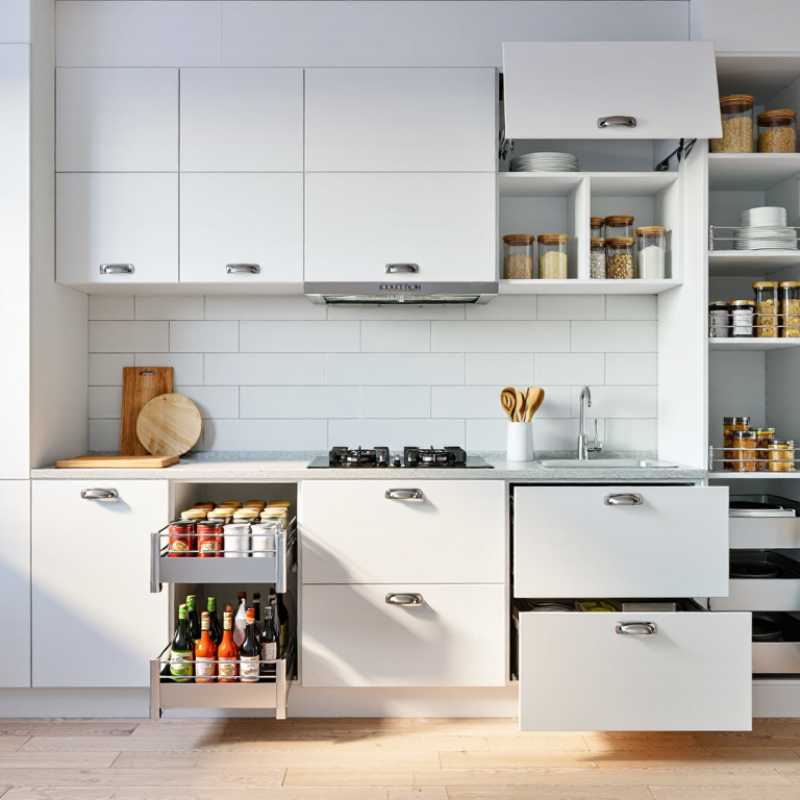
China Top Kitchen Storage Systems: What Makes Them Efficient?
In kitchen planning work, I often see Chinese manufacturers produce several practical storage systems. Drawer organizers are common for cutlery, pans, and preparation tools. Full-extension drawers let users reach items at the back without kneeling. Small details matter.
Tall pantry units use vertical space beside refrigerators or ovens. Adjustable shelves can hold cereal boxes, jars, and small appliances. Pull-out baskets are useful in narrow gaps, especially between cabinets and walls. Corner carousel units also reduce wasted space in difficult cabinet angles. Some projects use rotating trays, while others use swing-out frames for easier access.
Wall-mounted racks provide quick storage for spices, utensils, and mugs. They keep busy worktops clearer. Under-sink systems often include sliding trays and removable containers. These features help separate cleaning supplies from plumbing pipes. Modular cabinet inserts are another widely made option. They can be changed when household needs grow.
In my experience, efficient storage depends on accurate measurements, not just attractive hardware. A drawer may look spacious but fail when hinges or pipes block movement. I have seen plans overlook door clearance. That mistake can make a good system frustrating. Soft-closing tracks feel refined, yet they need proper installation and regular checking. Materials, load capacity, moisture resistance, and replacement parts deserve equal attention. Sometimes a simpler shelf works better than a complicated mechanism.
Efficient kitchen storage begins with a clear relationship between daily tasks and cabinet placement. Frequently used items should stay near the preparation area, not hidden above head height. Deep drawers work well for pots, while shallow drawers keep utensils visible and organized. Small details matter.
Vertical dividers can separate baking trays, chopping boards, and serving plates without wasting side space. Adjustable shelves respond better to changing cookware than fixed shelves. Pull-out units also improve access, especially in narrow cabinets. Corners need attention. A rotating shelf or sliding basket can recover awkward space, but the mechanism must move smoothly under regular loads.
Durable surfaces, strong hinges, and easy-clean finishes support long-term reliability. From practical kitchen planning, I have found that storage efficiency depends more on access than capacity. A crowded cabinet may hold more, yet still waste time every morning. Clearances should be checked with doors, handles, and appliances open. This step is often overlooked. I once preferred deeper shelves, but they created hidden stacks and expired ingredients. Shallower storage proved less impressive visually, but more useful in daily work. Good systems should also allow repairs and adjustments instead of forcing complete replacement. Even the best layout deserves review after real household use.
| Core Design Feature | Typical Specification or Data Range | How It Improves Storage Efficiency | Best-Suited Kitchen Items | Practical Design Considerations |
|---|---|---|---|---|
| Full-extension drawer runners | Common drawer depths: 450–600 mm; typical rated loads: 30–60 kg for household systems | Provides access to nearly the entire drawer depth, reducing unused rear space and making contents easier to identify. | Pots, pans, plates, food containers, and small appliances | Load capacity should match the drawer width, runner quality, fixing method, and expected frequency of use. |
| Adjustable internal dividers | Divider spacing is commonly adjustable in increments of approximately 25–50 mm | Matches storage compartments to item sizes, limiting empty gaps and preventing contents from shifting. | Cutlery, utensils, knives, lids, and kitchen tools | Use moisture-resistant materials and rounded edges for easier cleaning and safer handling. |
| Tall pull-out pantry storage | Typical cabinet widths: 150–300 mm; common cabinet heights: 1,800–2,200 mm | Uses narrow vertical cabinet zones that are often difficult to access with fixed shelves. | Dry foods, bottles, cans, spices, and packaged ingredients | Heavy items should be placed on lower shelves; anti-tip protection and stable runners are important. |
| Corner cabinet mechanisms | Designed for corner cabinet depths commonly around 500–600 mm | Converts difficult-to-reach corner volume into rotating, sliding, or pivoting storage. | Cookware, serving dishes, appliances, and larger containers | The mechanism must leave clearance for doors, adjacent cabinets, plumbing, and cabinet hinges. |
| Two-tier shelf inserts | Typical insert heights: 100–180 mm; commonly made from coated steel, aluminum, wood, or plastic | Divides one tall shelf into two usable levels, improving visibility and reducing vertical dead space. | Bowls, cups, cans, jars, and small plates | The upper tier should provide enough clearance for the items below without blocking visibility. |
| Under-sink modular storage | Configurable around common cabinet widths of 600–900 mm and plumbing obstacles | Uses the irregular space around drainage pipes and water supplies instead of leaving it inaccessible. | Cleaning products, waste bins, sponges, and replacement supplies | Select corrosion-resistant surfaces and removable trays to manage leaks and simplify cleaning. |
| Vertical tray and divider storage | Typical divider spacing: 50–100 mm, depending on tray and board thickness | Stores flat items upright, reducing stacking and allowing individual pieces to be removed without unloading the cabinet. | Baking trays, chopping boards, serving platters, and pan lids | Add non-slip bases or retaining rails to prevent items from sliding during drawer movement. |
| Integrated waste-sorting pull-outs | Common configurations: 2–4 bins; household bin volumes often total 30–60 L | Consolidates waste and recycling containers inside one accessible cabinet zone while keeping the floor clear. | General waste, recyclables, compost, and cleaning accessories | Allow ventilation, easy bin removal, leak protection, and sufficient clearance for cabinet doors. |
| Soft-close and damped movement | Usually applied to drawers, doors, baskets, and pull-out pantry units | Controls closing speed, reduces impact, and helps protect stored items and cabinet connections. | All frequently used cabinet and drawer contents | Performance depends on total load, alignment, temperature, installation accuracy, and cycle frequency. |
| Modular and adjustable installation | Common cabinet modules are based on approximately 300, 450, 600, and 900 mm widths | Allows storage components to be adapted to different cabinet layouts, household needs, and future changes. | Mixed kitchen inventory and changing storage requirements | Confirm cabinet inner dimensions, door opening angle, mounting points, and plumbing or electrical obstructions. |
| Moisture-resistant and easy-clean surfaces | Typical options include powder-coated steel, anodized aluminum, stainless steel, sealed wood panels, and washable polymers | Supports long-term hygiene and reduces maintenance in areas exposed to steam, spills, grease, and cleaning chemicals. | Under-sink supplies, food storage accessories, dishware, and daily-use tools | Material selection should consider corrosion resistance, load requirements, edge sealing, and compatibility with household cleaners. |
Note: Specifications are representative planning ranges for residential kitchen storage systems. Actual dimensions, load ratings, and configurations vary according to cabinet construction, installation conditions, and local standards.
In kitchen installation work, I have found that material selection affects daily performance more than appearance. Stainless steel, especially corrosion-resistant grades, handles steam, oil, and frequent cleaning well. Aluminum keeps frames light without feeling weak. Engineered panels and reinforced polymers can reduce cost while supporting organized drawers. Food-contact areas should use tested, low-odor materials. Small details matter.
Manufacturing standards make these materials dependable. Controlled cutting creates consistent dimensions, while robotic or carefully inspected welding improves joint strength. Good factories check surface thickness, coating adhesion, drawer alignment, and load capacity. They may also perform salt-spray, opening-cycle, and vibration tests. Quality systems such as ISO 9001 can support traceability, but certification alone proves little without clear inspection records. I look for batch numbers, test data, and practical warranty terms.
Efficiency also depends on tolerances. A drawer that shifts two millimeters can scrape, collect dirt, or close unevenly. Smooth edges reduce hand injuries during busy preparation. Properly fitted hinges prevent sagging under repeated use. Still, no storage system is perfect. I have seen attractive coatings chip around poorly finished screw holes. Overloaded baskets can fail faster than expected. Installation accuracy, cleaning habits, and realistic weight limits remain essential. A strong product can still perform poorly when these details are ignored.
Modular kitchen layouts make storage work like a quiet, adjustable machine. Cabinets, drawers, and shelves can be rearranged as cooking habits change.
This demand reflects a practical problem: fixed shelves often hide small tools and waste corner space.
Deep drawers place pans near hand level, reducing awkward bending. Pull-out units can bring spices and bottles into clear view.
Tall cabinets use vertical space for trays, cleaning tools, and dry goods. Adjustable shelves support different container sizes, although poorly planned modules can still create narrow, unused gaps.
Measure real objects, not empty cabinet boxes.
Accessibility improves when frequent items stay between knee and shoulder height. A modular layout can also separate preparation, cooking, and washing zones.
The National Kitchen and Bath Association’s 2024 design guidance emphasizes clearances, task lighting, and ergonomic reach ranges. These details matter more than decorative complexity.
In a small kitchen, a 300-millimeter drawer may serve better than a wide cupboard with a dark rear corner.
Yet modular systems are not automatically efficient. Hardware quality, installation accuracy, and daily user behavior decide whether the layout actually performs.
Comparing China’s top kitchen storage systems requires more than checking price. Efficiency begins with usable capacity, not crowded cabinets. Measure wall depth, corner angles, and appliance clearances before reviewing layouts. A 600-millimeter cabinet may look standard, yet plumbing can reduce its real storage. Pull-out baskets, deep drawers, and vertical dividers should match daily cooking habits. Soft-close hardware matters, but smooth movement under load matters more. Test a drawer with heavy pans. Small detail. Measure twice.
Material quality deserves close inspection. Ask for panel thickness, edge-sealing methods, corrosion resistance, and moisture performance. Kitchens produce steam, oil, and repeated spills. A durable surface should remain stable near sinks and ovens. Request samples, installation drawings, and load ratings before approving production. Independent testing reports can support claims about formaldehyde emissions and hardware endurance. Certificates alone are not enough. Check the issuing body, test date, and applicable standard. Some quotations exclude organizers, handles, or delivery protection, which can distort comparisons.
A reliable supplier should explain tolerances, replacement procedures, and after-sales support in writing. Confirm how damaged parts are identified and shipped. Clear numbering on every cabinet reduces installation mistakes. Lead time also deserves attention, especially for custom sizes. Low cost can become expensive when a missing panel delays the entire kitchen. I have found that detailed measurement records prevent more problems than attractive drawings. Still, no system is perfect. A clever corner unit may waste space if its door swing conflicts with a nearby oven. Compare performance in your room, not only in a showroom.
Keep frequently used items near the preparation area. Avoid placing them above head height. Short travel saves time.
Deep drawers suit pots and pans. Shallow drawers keep utensils visible and easier to organize. Visibility matters.
Vertical dividers separate trays, chopping boards, and serving plates. They use narrow side space efficiently. No messy leaning stacks.
Adjustable shelves fit changing cookware and container sizes. Fixed shelves may leave unused gaps. Measure real objects carefully.
Rotating shelves or sliding baskets can reach awkward corners. The mechanism must move smoothly under regular loads. Test it fully.
Corrosion-resistant metal handles steam, oil, and frequent cleaning well. Lightweight metal can reduce frame weight. Engineered panels may lower costs.
Check drawer alignment, surface thickness, coating adhesion, and load capacity. Inspection records provide useful evidence. Certification alone proves little.
Modular cabinets can adapt as cooking habits change. Deep drawers place pans near hand level. Pull-out units reveal spices and bottles.
Overloaded baskets may fail quickly. Poor installation can cause scraping or uneven doors. I once preferred deeper shelves, but hidden stacks wasted time.
Open doors, handles, and appliances during clearance checks. Watch how the household uses each cabinet. A beautiful layout may still need adjustment.
China’s kitchen storage systems are designed to combine practical organization with efficient use of space. Common options include modular cabinets, pull-out baskets, drawer organizers, corner units, tall pantry systems, wall-mounted storage, and integrated solutions for waste sorting and cookware. What makes a kitchen storage system efficient is its ability to make every area accessible while reducing clutter and unnecessary movement. Features such as adjustable shelves, smooth sliding mechanisms, tiered compartments, soft-closing hardware, and smart corner designs help users store more items in a clear and convenient way.
Performance also depends on suitable materials, accurate manufacturing, durable surface finishes, and consistent quality standards. Modular layouts allow cabinets and accessories to be adapted to different kitchen sizes, work zones, and user preferences. When comparing China’s top kitchen storage systems, buyers should consider space utilization, load capacity, accessibility, material durability, installation flexibility, maintenance requirements, and overall value. A well-designed system should improve daily workflow while remaining reliable, easy to clean, and adaptable to future kitchen changes.

NIXA Storage